
Supreme Court Junior Court Assistant Preparation Guide & E-Book
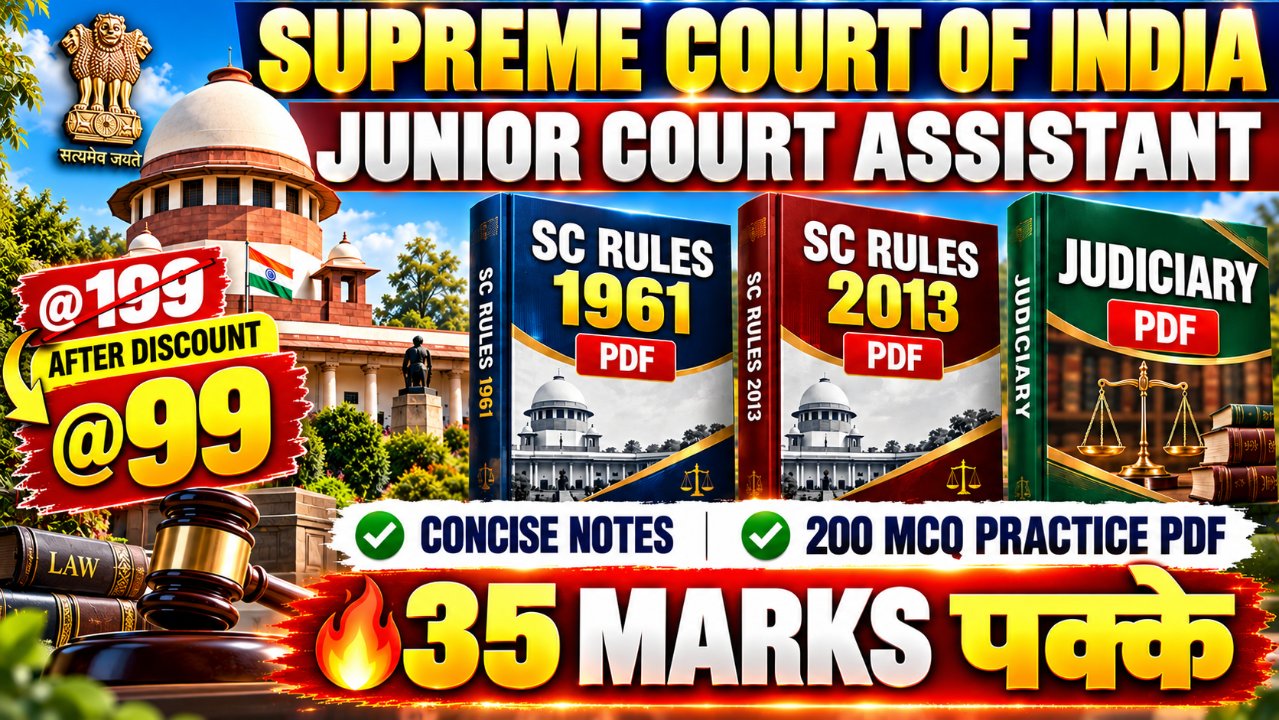
Preparing for an exam conducted by the highest judicial authority in India demands dedicated effort, structured reading, and precise study material. Candidates embarking on their Supreme Court Junior Court Assistant preparation often find it difficult to locate genuine, exam-focused study resources related to judicial rules and court administration. Because judicial exams require an understanding of relevant legal principles and service rules, having clear notes can make your daily study routine far more manageable.
Get the SC Rules & Judiciary E-Book Now
Understanding the Importance of Court Rules and Judiciary Notes
Working in the registry of the Supreme Court requires an awareness of how court operations, officers, and judicial processes function. Many aspirants spend hours searching the internet for unorganized documents or reading massive rulebooks that contain unnecessary details. Instead of trying to read hundreds of pages of unformatted text, studying through structured e-books helps you focus on what is relevant for your test.
Constitutional provisions and specific court rules form an important core of judicial understanding. When candidates read through organized notes on court rules alongside basic constitutional sections, they can connect theoretical concepts with administrative practices. For exact details regarding eligibility criteria, exam dates, syllabus weightage, and selection phases, candidates should always refer to the official notification published by the Supreme Court of India.
Key Focus: Supreme Court Rules 1961 and 2013
Two essential regulatory frameworks concerning the functioning and administration of the apex court are the Supreme Court Rules, 1961 and the Supreme Court Rules, 2013. Additionally, guidelines such as the SC Officers and Servants Rules, 1961 outline the structure and service conditions governing court staff.
Understanding these rules gives you a strong grounding in court administration. Rather than getting confused by dense legal jargon, reading concise and exam-focused notes helps you retain definitions, responsibilities, and procedural details effectively. Revising these rules through detailed summaries allows you to grasp the background of judicial administrative procedures without wasting precious preparation time.
Constitutional Foundations: Articles 124 to 147
The constitutional foundation of the Indian judicial system is established under Part V of the Constitution of India. Articles 124 to 147 deal specifically with the Union Judiciary, encompassing the establishment and constitution of the Supreme Court, the appointment of judges, jurisdiction, powers, and procedural rules.
When you prepare for a court assistant position, having clear notes on these articles is indispensable. Understanding these constitutional articles ensures that you have a solid grasp of how the Supreme Court derives its powers, how appeals operate, and how the court acts as a court of record. A systematic breakdown of Articles 124 to 147 helps streamline your revision so you can recall critical constitutional provisions easily.
What the Supreme Court SC Rules & Judiciary E-Book Includes
To support your study routine, Selection Lab offers a complete digital study package designed specifically for students aiming for the Junior Court Assistant examination. This package contains concise, exam-focused notes that bring together all vital topics in one place.
Here is what you will receive inside the digital package:
- Supreme Court Rules 1961 E-Book: Accessible digital reading material on the 1961 rules.
- Supreme Court Rules 2013 E-Book: Clear study material explaining the updated 2013 rules.
- Judiciary E-Book: Comprehensive coverage of core judicial concepts for quick reading.
- Articles 124-147 Notes: Direct, organized notes on constitutional provisions related to the Union Judiciary.
- SC Officers Servants Rules 1961 Notes: Both concise summaries and detailed study notes on servant and officer rules.
- 200 MCQ Practice Questions: Multiple-choice questions designed to help you test your understanding and practice topic-wise recall.
- 180 Days Validity: Full digital access for six months to revise at your own pace.
Tips for Supreme Court Junior Court Assistant Preparation
A planned study strategy is essential when working through specialized legal rules and judicial content. Here are a few practical recommendations to make your study hours count:
1. Build a Consistent Study Schedule
Divide your daily study time into dedicated slots for reading notes and testing yourself. Even spending an hour or two every day on court rules and judiciary concepts can help you build steady momentum.
2. Focus on Summaries First
Begin by reading concise notes before moving on to detailed sections. Grasping the overview of the SC Officers and Servants Rules, 1961 and the Supreme Court Rules, 2013 gives you context, making detailed study notes much easier to digest.
3. Test Yourself with Practice Questions
Passive reading is rarely enough for retention. Solve multiple-choice questions after completing each topic to see how well you remember facts, definitions, and rule numbers. Practicing the 200 MCQ questions included in your package will help pinpoint areas where you need further review.
4. Review Constitutional Articles Regularly
Articles 124 to 147 contain specific clauses regarding appointments, jurisdiction, and court authority. Create quick revision sheets or revisit your digital notes frequently so that you retain key provisions with precision.
Affordable Preparation with Selection Lab
Quality exam preparation does not have to be expensive. The Supreme Court SC Rules 1961 & 2013 + Judiciary E-Book package is available for just ₹99, discounted from its regular price of ₹199. With digital access valid for 180 days, you can study from the comfort of your home, revisit tough topics whenever you need, and practice questions on your phone or computer.
Organizing your notes early saves valuable time and keeps your studies disciplined. Take charge of your preparation with structured, exam-oriented study materials today.
Frequently Asked Questions
What is included in the Supreme Court SC Rules & Judiciary E-Book package?
What is the price and validity of this digital package?
How many practice MCQs are provided in this course?
Does the course cover constitutional articles related to the judiciary?
Where can I find official details about exam dates and eligibility?
Try our free mock tests on the real exam interface.