
Economics Notes for Competitive Exams: SSC, Railway & State PSC
Preparing for Indian government competitive examinations requires a strong grasp of General Awareness. Whether you are aiming for SSC, Railway, State PSC, or Court Exams, General Awareness can significantly impact your overall score. Among the various subjects under this section, Economics is a key topic that frequently features direct and analytical questions. Securing reliable Economics Notes for Competitive Exams is an effective step toward mastering concepts like national income, budgeting, and financial institutions without getting overwhelmed by heavy textbook theory.
Understanding Economics for General Awareness
Economics measures how financial systems, policies, and markets function across the country. In competitive tests such as SSC exams, Railway recruitments, State Public Service Commission (PSC) tests, and High Court clerk positions, questions from Economics test basic awareness of economic principles and Indian economic structures. Candidates should always refer to the official notification of their targeted recruitment drive to understand the exact syllabus distribution and exam pattern details.
Many candidates struggle with Economics because standard textbooks often present concepts in complex academic terminology. However, competitive exams primarily focus on fundamental clarity, policy awareness, historical economic planning, and key terminology. Studying systematically structured notes helps you convert abstract concepts into actionable exam knowledge.
Important Topics Included in Competitive Economics
To perform well in General Awareness sections, candidates must focus on key areas of the Indian Economy and core economic theories. Below are some primary topics covered during general exam preparation:
- Basic Economic Concepts: Understanding fundamental principles, economic sectors, supply and demand basics, and key terminology.
- National Income & GDP: Indicators of economic growth, Gross Domestic Product, Gross National Product, and calculation fundamentals.
- Inflation & Monetary Policy: Types of inflation, consumer and wholesale price indices, and tools used by financial institutions.
- Banking System: Functions of the central bank, commercial banking, monetary instruments, and financial sector reforms.
- Budget & Economic Planning: Union Budget structure, fiscal policies, revenue and capital balance, and Five-Year Plans.
- Poverty, Unemployment & Schemes: Key social indicators, measurement metrics, and major government initiatives aimed at economic development.
- Agriculture, Industry & External Sector: Contributions of primary and secondary sectors, trade balance, foreign reserves, and international financial bodies.
Smart Tips to Prepare Economics for Government Exams
Success in General Awareness requires smart planning rather than rote memorization. Here are practical strategies to build strong economics comprehension:
1. Focus on Conceptual Fundamentals
Start by learning basic definitions and mechanisms. Understand how inflation affects purchasing power, how central banks control money supply, and how national budget categories differ. Once concepts are clear, answering objective questions becomes easier.
2. Practice Previous Year Questions (PYQs)
Previous year questions highlight the depth and frequency of specific topics. Reviewing PYQs helps you spot repeated patterns, standard question formats, and key emphasis areas across different exam boards.
3. Utilize Visual Learning Aids
Economics involves multiple relationships between indicators. Using flowcharts, mind maps, tables, and comparative charts can help you memorize complex relationships such as fiscal metrics or banking rates faster.
4. Implement Short Memory Tricks
Remembering lists like Five-Year Plan focus areas, historical dates, or government scheme objectives can be simplified with short memory tricks and mnemonics. These techniques save valuable revision time before exam day.
Why Use Selection Lab's Economics Notes for Competitive Exams?
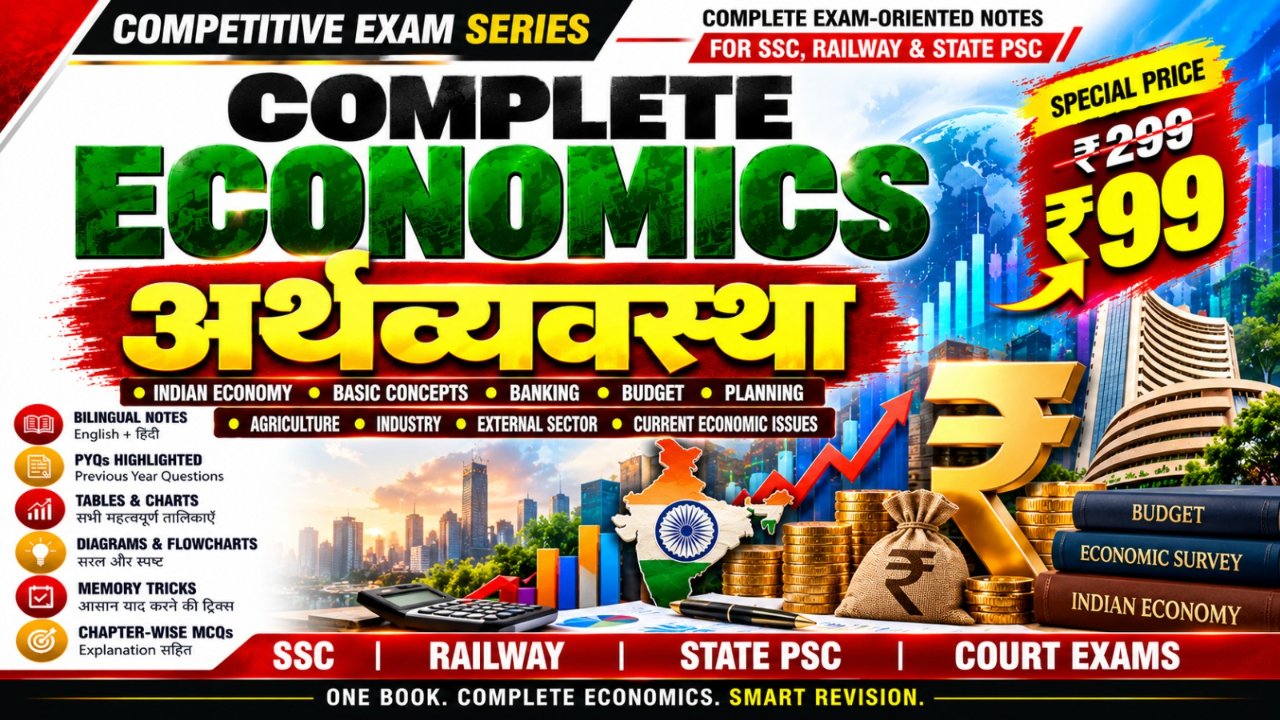
To simplify your preparation journey, Selection Lab offers a complete study resource designed specifically for competitive exam aspirants. Here is what is included in this study package:
- Bilingual Content: Complete study material provided in both Hindi and English (अर्थव्यवस्था नोट्स) to accommodate regional and English-medium students.
- Comprehensive Subject Coverage: Clear notes on Indian Economy, Banking, Budget, Economic Planning, GDP, Inflation, Agriculture, Industry, Poverty, and Government Schemes.
- Chapter-Wise MCQs: Dedicated Multiple Choice Questions following each topic with clear answers and detailed explanations for self-assessment.
- Previous Year Questions: Exam-focused PYQs to give you practical insight into real exam scenarios.
- Visual Study Materials: Includes tables, charts, flowcharts, and memory tricks for rapid revision and easy retention.
- Affordable Access: Available at an accessible price of ₹99 (discounted from original price of ₹299) with 180 days of validity.
Building a Revision Routine for Best Results
Consistency is essential when preparing for competitive exams. Allocate regular study slots in your daily schedule for General Awareness. Begin by reading topic-wise theory, immediately followed by practicing chapter-wise MCQs. Revisit difficult topics using summary tables and flowcharts every week.
While structured study notes provide guidance and clarity, consistent effort, regular revision, and self-evaluation remain the true keys to improving your score. Always verify official notifications for exact exam rules, updates, and syllabus guidelines.
Frequently Asked Questions
Are these Economics notes available in both Hindi and English?
Which exams can I prepare for using this Economics course?
Does the course include practice questions and PYQs?
How long will I have access to the study material?
Does enrolling in this course guarantee exam selection?
Try our free mock tests on the real exam interface.