
Supreme Court of India MCQ Guide: How to Ace SCI Preparation
Preparing for competitive government and judicial examinations requires a clear study strategy, strong conceptual clarity, and regular question practice. When preparing for judicial, court clerk, or general awareness sections, practicing a dedicated Supreme Court of India MCQ series is one of the most effective ways to consolidate your learning. The judiciary plays a central role in Indian governance, making topics related to the Supreme Court highly relevant across several competitive tests. In this comprehensive guide, we will share essential preparation strategies and show you how structured practice sets can elevate your exam readiness.
Why Practicing Supreme Court of India MCQ Sets is Essential
Multiple-choice questions do much more than test your knowledge. They actively challenge your memory, force you to distinguish between similar options, and help you identify gaps in your understanding. Solving targeted practice sets allows candidates to build speed and accuracy simultaneously.
When you solve a targeted Supreme Court of India MCQ, you train your brain to quickly identify key facts, judicial functions, and constitutional references. Regular practice reduces exam-day anxiety because you become accustomed to reading options carefully and avoiding common tricky pitfalls that examiners set.
How to Approach Judiciary and Legal Awareness Preparation
Candidates preparing for court recruitment or administrative exams must adopt a systematic approach to study the judiciary. Before diving into revision, it is vital to know that every exam conducting body releases a official notification outlining specific rules. Always check the official notification for official details regarding exam dates, age limits, vacancy numbers, eligibility criteria, and detailed syllabus guidelines, as these can vary across recruitment drives.
1. Understand the Basics of the Judicial Framework
Begin by studying the structure, jurisdiction, powers, and role of the highest judicial forum in the country. Focus on understanding fundamental concepts rather than simply memorizing answers. Understanding the background makes answering objective questions much easier.
2. Focus on Objective Revision
After reading your primary theoretical study materials, transition immediately to objective questions. Solved questions serve as quick revision notes. If you get a question wrong, revisit the underlying concept right away to ensure you do not repeat the mistake.
Proven Tips for Scoring High in Competitive Exams
Scoring well in objective tests requires a combination of subject knowledge, time management, and test-taking strategy. Here are proven tips to boost your performance:
- Maintain a Mistakes Log: Whenever you attempt a practice test, write down the questions you answered incorrectly. Reviewing this log daily ensures continuous improvement.
- Practice Elimination Techniques: In objective exams, if you do not know the exact answer immediately, eliminate options that are clearly incorrect to increase your chances of choosing the right option.
- Time-Bound Practice: Always practice questions with a clock running. Improving your reading speed helps you reserve crucial time for difficult sections during the actual examination.
- Consistent Daily Revision: Set aside at least 30 minutes every day exclusively for solving practice sets and revising key highlights.
What is Included in SCI Top 500 MCQs Course
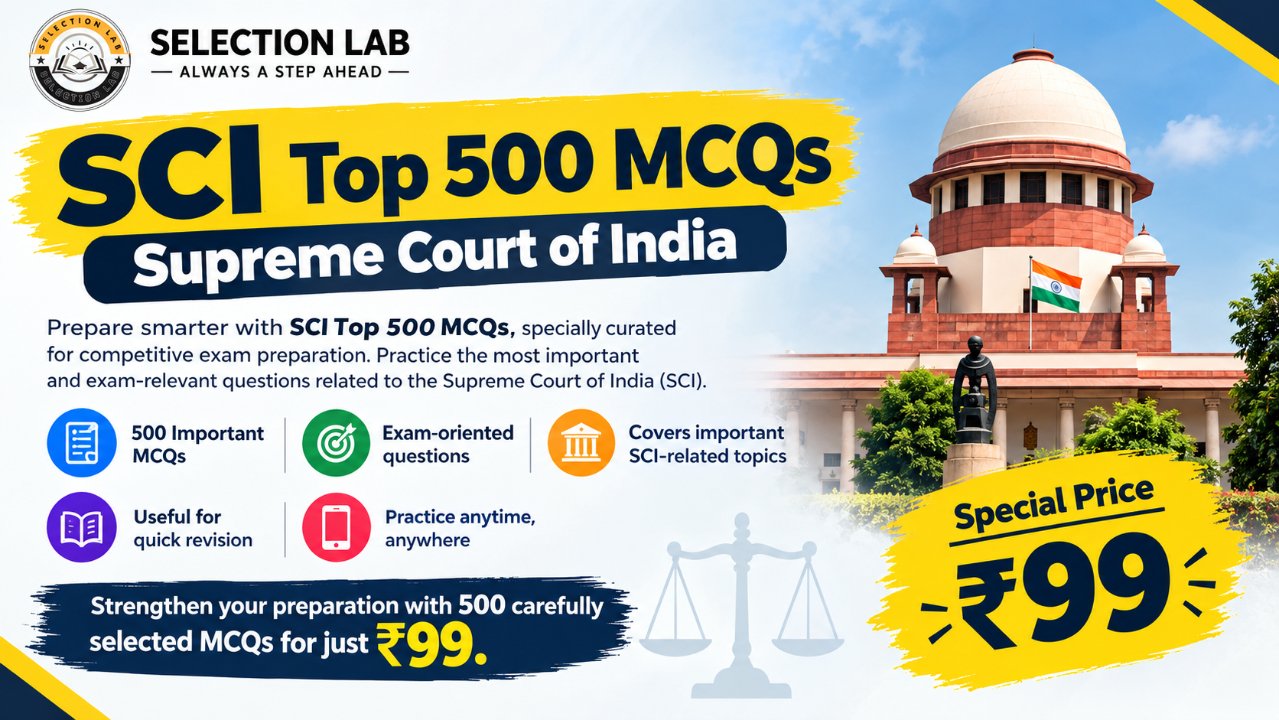
To help you prepare smarter and revise faster, Selection Lab offers a dedicated practice course specially curated for aspirants. The course is designed to provide maximum value and focused learning at an affordable price point.
Here is what you get inside the SCI Top 500 MCQs course:
- 500 Important MCQs: A carefully selected set of 500 objective questions relevant for competitive exams.
- Exam-Oriented Questions: Specially curated content focusing on key topics related to the Supreme Court of India (SCI).
- Quick Revision Tool: Designed specifically to assist candidates in fast and effective last-minute revision.
- Practice Anytime, Anywhere: Complete flexibility to access your study material on modern devices whenever you have spare time.
- 1-Year Validity: Course access stays active for 365 days, giving you ample time to revise repeatedly.
- Special Affordable Pricing: Available at a special price of ₹99 (original price ₹199).
- Single Curated Module: Includes a complete Top 500 MCQ collection tailored for serious aspirants.
Smart Revision Strategy Before Exam Day
In the final weeks before your exam, shift your primary focus from reading new heavy books to solving and revising question sets. High-yield revision involves attempting sets of 50 to 100 questions in one sitting, analyzing your score, and reading the correct explanations.
By working through structured question sets like the SCI Top 500 MCQs, you ensure that important topics are fresh in your memory. While consistent revision and objective practice significantly improve your preparation level, remember that selection depends entirely on your total hard work, comprehensive preparation across all subjects, and exam-day execution.
Conclusion
Preparing for judiciary-related topics does not have to be overwhelming. With a structured approach, clear study habits, and consistent objective practice, you can master these sections efficiently. Make sure you regularly check official government notifications for all official parameters like exam dates, rules, and syllabi. Take advantage of focused practice tools to sharpen your skills and test your knowledge under realistic conditions.
Frequently Asked Questions
How many questions are included in the SCI Top 500 MCQs course?
What is the price and validity of this online course?
Where can I find details like exam dates, age limit, and syllabus?
Does buying this course guarantee my selection in the exam?
Try our free mock tests on the real exam interface.